


The Foundations unit (Unit I) will only be approximately 5% of the AP World exam in the spring, the Classical Era is where what the average person thinks of as history really starts. It is in this time period that world regions really begin to take on a recognizable "character". This is where "Europe" takes shape under the Roman Empire. This is where China becomes China, India becomes India and so on . . . . This time period really focuses on classical civilizations, beliefs systems and the beginnings of inter-regional trade networks.
Unit II in Maps
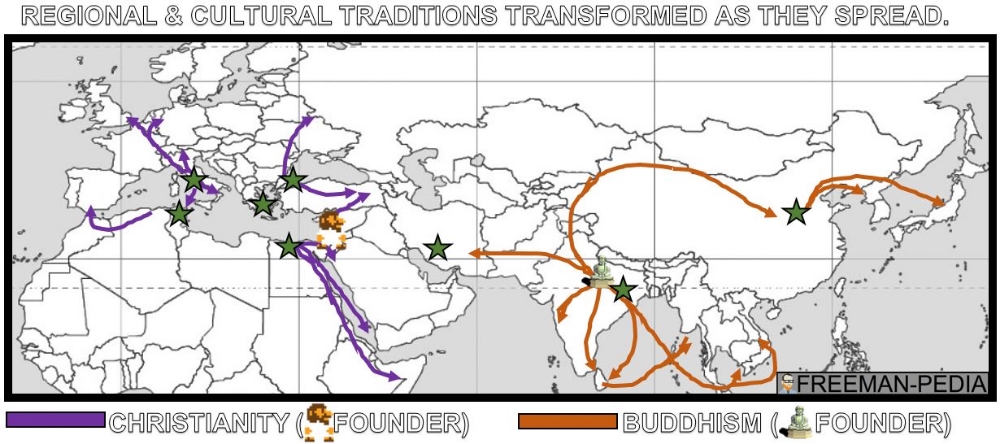
Spread of Major Classical Era Belief Systems
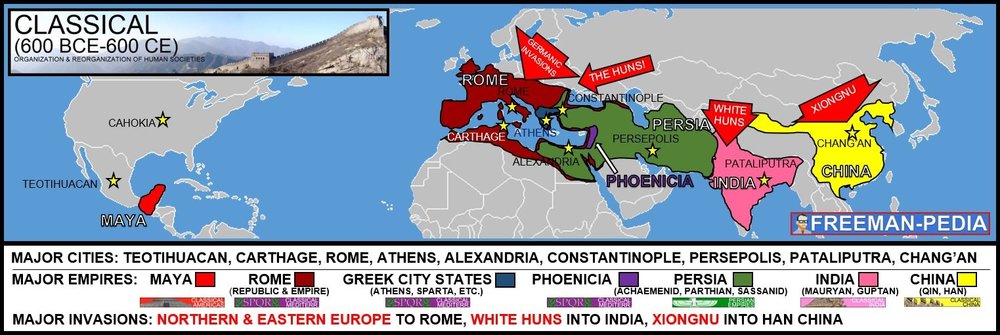
Classical Civilizations (600 BCE to 600 CE)
Classical Era Trade Routes (by 600 CE)


Unit II Key Concepts
The Classical Era => ORGANIZATION & REORGANIZATION OF HUMAN SOCIETIES C. 600 B.C.E. TO 600 C.E
KEY CONCEPT 2.1: The DEVELOPMENT & CODIFICATION of RELIGIOUS & CULTURAL TRADITIONS
As states and empires increased in size and contacts between regions multiplied, religious and cultural systems were transformed. Religions and belief systems provided a bond among the people and an ethical code to live by. These shared beliefs also influenced and reinforced political, economic, and occupational stratification. Religious and political authority often merged as rulers (some of whom were considered divine) used religion, along with military and legal structures, to justify their rule and ensure its continuation. Religions and belief systems could also generate conflict, partly because beliefs and practices varied greatly within and among societies.
1. Codifications and further developments of existing religious traditions provided a bond among the people and an ethical code to live by.


2. New belief systems and cultural traditions emerged and spread, often asserting universal truths.





3. Belief systems affected gender roles. Buddhism and Christianity encouraged monastic life and Confucianism emphasized filial piety.

4. Other religious and cultural traditions continued parallel to the codified, written belief systems in core civilizations.
- Shamanism and animism continued to shape the lives of people within and outside of core civilizations because of their daily reliance on the natural world.
- Ancestor veneration persisted in many regions (Africa, Mediterranean region, East Asia, Andean areas (this site is on Incan ancestor worship that was derived from earlier beliefs).

5. Artistic expressions, including literature and drama, architecture, and sculpture, show distinctive cultural developments.
- Literature and drama (Greek Plays, Indian Epics)acquired distinctive forms that influenced artistic developments in neighboring regions and in later time periods.

- Distinctive architectural styles developed in many regions in this period (India, Greece, Roman Empire, Mesoamerica).

- Arts and Architecture reflected the values of religions and belief systems


KEY CONCEPT 2.2: The DEVELOPMENT of STATES & EMPIRES
As the early states and empires grew in number, size, and population, they frequently competed for resources and came into conflict with one another. In quest of land, wealth, and security, some empires expanded dramatically. In doing so, they built powerful military machines and administrative institutions that were capable of organizing human activities over long distances, and they created new groups of military and political elites to manage their affairs. As these empires expanded their boundaries, they also faced the need to develop policies and procedures to govern their relationships with ethnically and culturally diverse populations: sometimes to integrate them within an imperial society and sometimes to exclude them. In some cases, these empires became victims of their own successes. By expanding their boundaries too far, they created political, cultural, and administrative difficulties that they could not manage. They also experienced environmental, social, and economic problems when they overexploited their lands and subjects and permitted excessive wealth to be concentrated in the hands of privileged classes.
1. The number and size of key states and empires grew dramatically by imposing political unity on areas where previously there had been competing states.
- Required examples of key states and empires (Student should know the location and names):

Click image for more . . .

Click image for more . . .

Click image for more . . .

Click image for more . . .

2. Empires and states developed new techniques of imperial administration based, in part, on the success of earlier political forms.
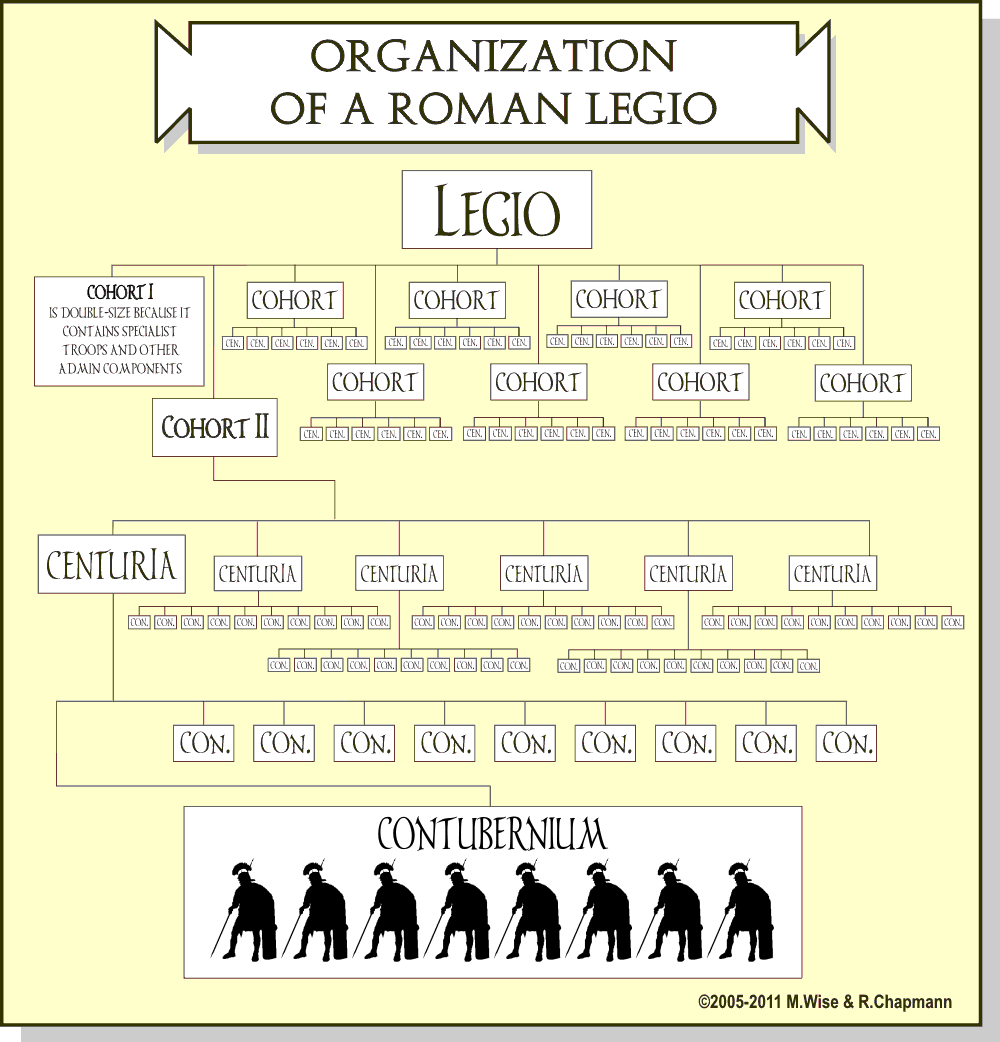
- In order to organize their subjects, the rulers created administrative institutions in many regions (China, Persia, Rome, South Asia).
- Required examples of administrative institutions: Centralized Governments & Elaborate legal systems and bureaucracies


Imperial governments projected military power over larger areas using a variety of techniques. Required examples of such techniques:
-Diplomacy
-Developing supply lines
-Building fortifications, defensive walls, and roads
-Drawing new groups of military officers and soldiers from the local populations or conquered people

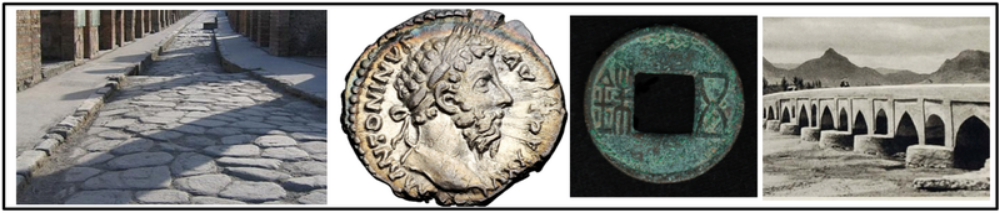
- Much of the success of the empires rested on their promotion of trade economic integration by building and maintaining roads and issuing currencies
3. Unique social and economic dimensions developed in imperial societies in Afro-Eurasia and the Americas.

- The social structures of empires displayed hierarchies that included cultivators, laborers, slaves, artisans, merchants, elites, or caste groups.


- Patriarchy continued to shape gender and family relations in all imperial societies of this period.

4. The Roman, Han, Persian, Mauryan, and Gupta empires created political, cultural, and administrative difficulties that they could not manage, which eventually led to their decline, collapse, and transformation into successor empires or states. (2013 CONTINUITY & CHANGE OVER TIME ESSAY)


- Through excessive mobilization of resources, imperial governments caused environmental damage (deforestation, desertification, soil erosion, silted rivers) and generated social tensions and economic difficulties by concentrating too much wealth in the hands of elites.
- External problems resulted from security issues along their frontiers (between Han China and Xiongnu, between Gupta and the White Huns, between the Romans and their northern and eastern neighbors) including the threat of invasions.

Fall of Classical Empires (VENN Diagram)
KEY CONCEPT 2.3: EMERGENCE OF TRANS-REGIONAL NETWORKS OF COMMUNICATION & EXCHANGE
With the organization of large-scale empires, the volume of long-distance trade increased dramatically. Much of this trade resulted from the demand for raw materials and luxury goods. Land and water routes linked many regions of the Eastern Hemisphere. The exchange of people, technology, religious and cultural beliefs, food crops, domesticated animals, and disease pathogens developed alongside the trade in goods across far-flung networks of communication and exchange. In the Americas and Oceania localized networks developed.
1. Land and water routes became the basis for transregional trade, communication, and exchange networks in the Eastern Hemisphere.

- Many factors, including the climate and location of the routes, the typical trade goods, and the ethnicity of people involved, shaped the distinctive features of a variety of trade routes.

- Innovations in maritime technologies (Lateen Sails, Dhow Ships), as well as advanced knowledge of the monsoon winds, stimulated exchanges along maritime routes from East Africa to East Asia

3. Alongside the trade in goods, the exchange of people, technology, religious and cultural beliefs, food crops, domesticated animals, and disease pathogens developed across far-flung networks of communication and exchange.
- The spread of crops, including rice and cotton from South Asia to the Middle East, encouraged changes in farming and irrigation techniques (The Qanat System, pictured here).
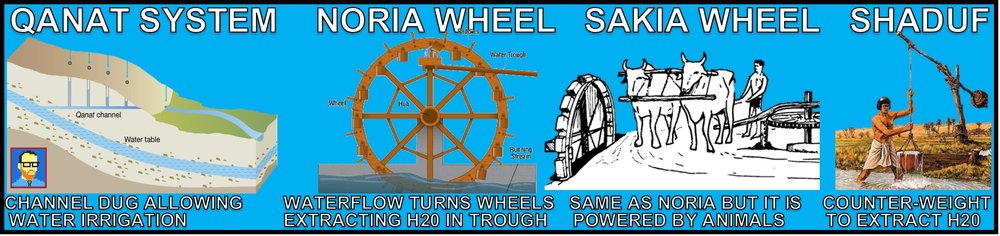
Qanats were used to grow cotton in the Middle East
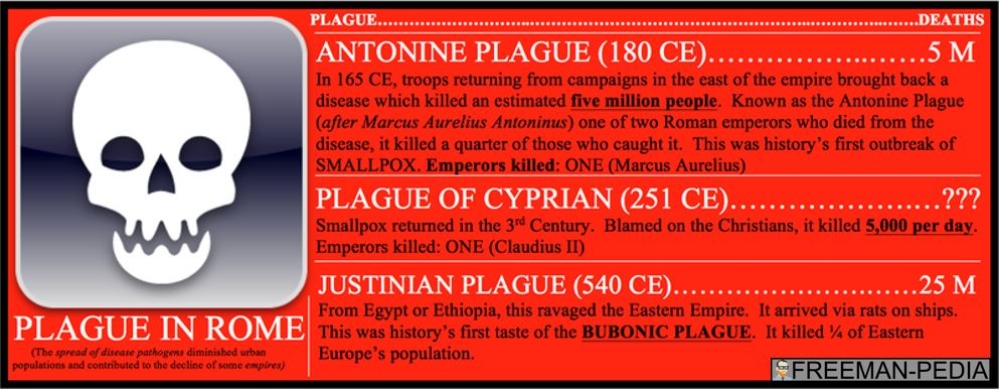
- The spread of disease pathogens diminished urban populations and contributed to the decline of some empires (Effect of disease on the Roman Empire, Effect of Disease on the Chinese Empires
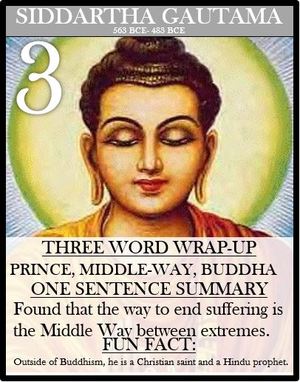
- Required examples of transformed religious and cultural traditions: BUDDHISM, HINDUISM, CHRISTIANITY
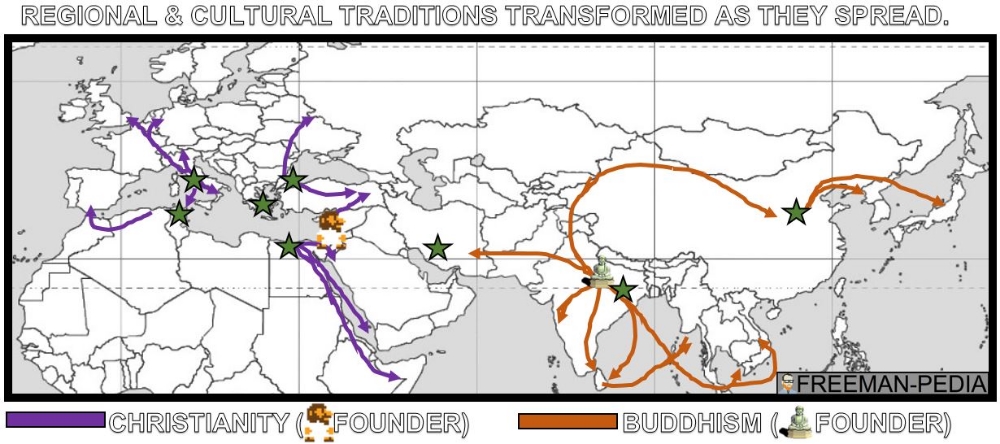
For more information about Religious and Cultural Transformations click HERE


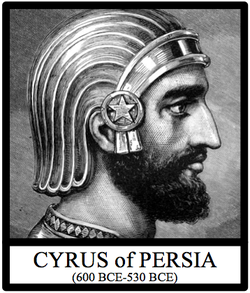
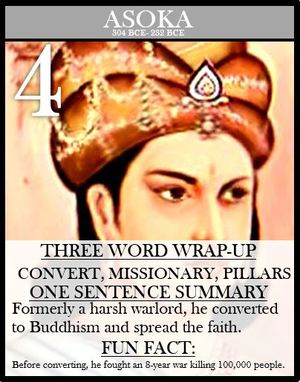
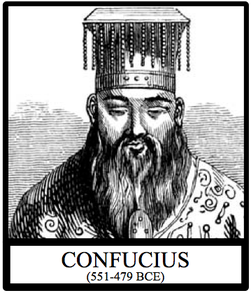
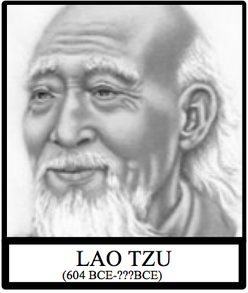
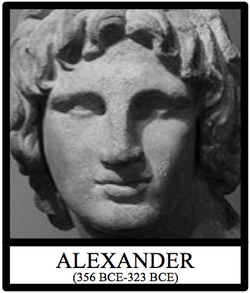
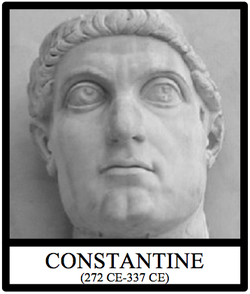

- TAO TE CHING, 550 BCE, Lao Tzu (CHINA)
- 12 TABLES, 451 BCE (ROME)
- LESSONS FOR WOMEN, 80 CE, Ban Zhao (CHINA)
- SERMON ON THE MOUNT, 90 CE (ROME)
- CODE OF JUSTINIAN, 529 CE, Justinian (BYZANTINE)
Videos and Links


The Following sites and materials are useful in reviewing the content of this unit
Freemanpedia => Unit II Review materials


Download these review materials HERE at Freemanpedia's site